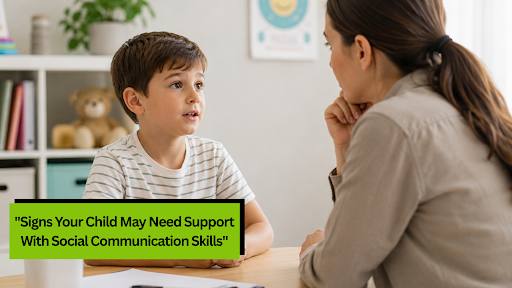
Social communication challenges may appear as difficulty with conversation, play, social cues, or perspective-taking. Early support can build confidence and connection.
A child can have plenty to say and still find social communication difficult. You may notice that your child wants friends but does not know how to enter a game, talks at length about one favorite topic, misses facial expressions, or becomes confused when another child changes the rules. Sometimes these behaviors reflect personality or normal development. When difficulties persist and interfere with friendships, school, family life, or confidence, they deserve a closer look.
Understanding these differences is an important part of supporting child communication skills without making a child feel that something is “wrong” with them.
What Are Social Communication Skills?
Social communication skills are the abilities children use to connect with other people and make sense of interactions. They include verbal skills, such as starting a conversation, answering questions, staying on topic, and asking for clarification. They also include nonverbal communication, such as facial expressions, gestures, body language, personal space, and tone of voice.
Communications Is More Than Words
Consider a child saying, “That’s mine.” The words are simple, but the meaning can change depending on volume, facial expression, timing, and what happened before. Effective social communication requires a child to notice those details and respond appropriately.
Children also need to learn the back-and-forth nature of conversation: listening, responding, asking related questions, and recognizing when another person wants a turn. These skills develop gradually and vary with age, temperament, language ability, and individual differences.
Why Social Communication Skills Matter for Your Child
Strong social communication helps children participate in classrooms, build friendships, express needs, resolve disagreements, and develop a sense of belonging. It also supports independence because children need to ask for help, understand instructions, explain problems, and communicate boundaries.
Shared play provides a natural setting for practicing these skills. The American Academy of Pediatrics describes communication as including connection, emotion reading, perspective-taking, and problem-solving, not just expressing wants.
A child who has difficulty may become frustrated because they understand what they want socially but cannot consistently make it happen. For example, a child may genuinely want to join classmates but repeatedly interrupt or enter the game without understanding its rules. Helping the child learn the missing steps is often more useful than simply telling them to “be more social.”

Common Signs of Social Communication Challenges
There is no single behavior that proves a child has social communication difficulty. Look instead for patterns that occur across settings and continue over time.
Signs Parents May Notice
Common examples include:
● Difficulty starting or maintaining a conversation.
● Giving very short answers or talking extensively without noticing the listener’s response.
● Frequently interrupting or struggling to take conversational turns.
● Difficulty understanding jokes, sarcasm, indirect requests, or implied meaning.
● Missing facial expressions, gestures, tone changes, or other social cues.
● Difficulty recognizing personal space.
● Becoming upset when a conversation or activity changes direction.
● Struggling to join group play or understand unwritten rules.
● Repeated misunderstandings with peers that lead to conflict.
● Difficulty explaining feelings, needs, or what happened during a disagreement.
Social Skills: Building Blocks for Everyday Interaction
Social skills are practical behaviors that turn communication into successful interaction. Children learn them through modeling, practice, feedback, and real experiences. Important building blocks include greeting others, sharing attention, taking turns, listening, asking questions, respecting personal space, following group rules, and handling disagreements.
Seeing, Thinking, and Doing
NHWS describes social skills in terms of “seeing,” “thinking,” and “doing”: noticing social cues and context, interpreting what another person may mean or feel, and choosing an appropriate response.
This can explain why a child may appear to “know better” but still struggle. A child might notice that a classmate walked away but not understand that the classmate wants a break. Or they may understand the situation but freeze when deciding what to say.
At home, try asking, “What do you notice?” followed by, “What do you think they might be feeling?” and, “What could you do next?” The goal is flexible thinking, not one perfect response.
Peer Interactions and Play: Learning Through Connection
Friendships give children repeated opportunities to practice communication in situations that cannot always be scripted. Play requires children to negotiate roles, share materials, wait, compromise, respond to another person’s ideas, and recover when something goes wrong.
When a Child Wants Friends but Struggles to Join
A child may stand near other children and watch without joining. Another may enter a game by grabbing a toy rather than asking. These behaviors can reflect a skill gap rather than a lack of interest in friendship.
Start with manageable situations. A short activity with one familiar peer may be easier than a large group. Parents can model phrases such as “Can I play too?” or “What are you making?” and then give the child time to try. Structured games can create predictable opportunities for turn-taking and conversation.
Why Play Matters
Play lets children practice social communication while doing something meaningful. Pediatric guidance emphasizes shared play as a way to build back-and-forth communication, emotional awareness, and perspective-taking.

Perspective Taking: Understanding Others’ Thoughts and Feelings
Perspective taking means recognizing that another person can have thoughts, feelings, knowledge, preferences, or intentions that differ from your child’s. This skill develops over time and becomes more important as social situations become complicated.
Helping Children Read Social Situations
Instead of immediately explaining what another person feels, invite your child to consider possibilities. If a sibling stops playing, ask, “What do you think happened?” There may be several reasonable answers: they could be tired, frustrated, bored, or ready for a different activity.
Stories are another useful tool. Ask what a character knows, what they might be feeling, and what could happen next. This encourages children to look beyond their own viewpoint.
Interacting With Adults: Communication Beyond the Peer Group
Social communication challenges may also appear when children interact with teachers, relatives, coaches, or unfamiliar adults. A child might avoid answering questions, speak very quietly, provide excessive detail, or have trouble knowing how formal or informal to be.
Building Confidence With Adults
Practice in low-pressure situations. Before visiting a new place, explain who the child will meet and what questions might come up. Role-play asking for help, introducing themselves, answering a question, or explaining when they do not understand.
It is also helpful to teach repair strategies. Phrases such as “Can you say that again?” “I’m not sure what you mean,” and “Can I have a minute?” give children ways to keep an interaction going when communication breaks down.
When to Seek Support for Your Child’s Communication Development with NHWS
Consider professional guidance when social communication difficulties are persistent, occur in more than one setting, cause significant frustration, interfere with friendships or school participation, or seem out of step with your child’s development.
New Horizons Wellness Services (NHWS) provides social skills groups, pediatric occupational therapy and evaluation services. Its social skills programs address initiating interactions, turn-taking, sharing, following rules, recognizing social and nonverbal cues, emotional regulation, perspective-taking, and age-appropriate conversation.
NHWS also offers evaluations that examine areas including social-emotional functioning, behavior, adaptive functioning, and communication as part of a broader developmental picture. A thoughtful evaluation can help identify appropriate supports rather than relying on assumptions. Book a call now!

Frequently Asked Questions
Why does my child struggle to make friends even though they want to play with other children?
Wanting friendship and knowing how to create it are different skills. Your child may need help with entering play, reading cues, taking turns, negotiating, or keeping a conversation going. Guided practice can make these steps more manageable.
Is it normal for my child to prefer playing alone all the time?
Some children naturally enjoy solitary play and may still have healthy social relationships. It becomes more important to seek guidance when a child wants interaction but repeatedly cannot join, becomes distressed by social situations, or has persistent difficulty communicating with others.
Why does my child have difficulty understanding other people’s feelings?
Children develop emotional and perspective-taking skills gradually. Difficulty reading facial expressions, tone, context, or indirect communication can make other people’s feelings harder to interpret. Practice with stories and real-life situations can help.
How can I help my child become more confident when talking to adults?
Use short, low-pressure practice opportunities. Role-play greetings, asking for help, answering common questions, and requesting clarification. Focus on building confidence and functional communication rather than expecting a perfect response every time.
When should I become concerned about my child’s social communication development?
Pay attention to persistent patterns that affect friendships, school, family relationships, or daily functioning. A pediatric or developmental professional can help determine whether the concern reflects a communication difference, another developmental factor, or individual variation.
Yours in Health,
New Horizons Wellness Services8880 SW Nimbus Ave Suite C.,
Beaverton, OR 97008
- https://g.page/newhws
New Horizons Wellness Services provides a true multidisciplinary approach to mental & physical health treatments for children, adults and families.